
 4.6
4.6 4.2
4.2Key Takeaways
- Stripe charges 1.5% on stablecoin transactions, compared to 1% for Coinbase Commerce — a significant gap for high-volume merchants.
- Stripe processes over $1 trillion in annual payment volume (Stripe Sessions 2026) and acquired Bridge for $1.1 billion in October 2024, the largest acquisition in crypto history.
- Stablecoin transactions surpassed $8.5 trillion in 2024 according to Chainalysis — a market where Stripe and Coinbase are competing head-to-head.
- Coinbase Commerce leverages the x402 protocol (developed with Cloudflare) and Shopify's Commerce Payments Protocol to target web-native payments.
- Stripe is betting on fiat-to-crypto conversion and a banking strategy through Bridge (preliminary OCC charter approval in February 2026), while Coinbase is pushing crypto-native adoption on Base, Ethereum, Solana, and Polygon.
Stripe vs Coinbase Commerce: Two Fundamentally Different Philosophies
Stripe and Coinbase Commerce operate on the same turf — enabling merchants to accept crypto payments — but their approaches couldn't be more different.
Stripe is a fiat payment processor that bolts stablecoins onto its existing infrastructure. The company founded by Patrick and John Collison already processes over $1 trillion in annual volume, according to figures shared at Stripe Sessions 2026. Adding stablecoins is an incremental play: Stripe merchants keep their tech stack, their dashboards, their APIs — and simply gain an additional payment rail. As Unchained Crypto has analyzed, Stripe treats crypto as a value transport layer, not as an end in itself.
Coinbase Commerce takes the opposite stance. It's a crypto-native product, built from the ground up to work with wallets, blockchains, and tokens. The philosophy: the merchant accepts crypto, receives crypto, manages crypto. Coinbase, publicly traded on NASDAQ under the ticker COIN, leans on its broader ecosystem — the exchange, Coinbase Wallet, the Base network (Ethereum Layer 2) — to deliver an integrated experience for merchants already fluent in blockchain.
For a standard e-commerce business that wants to add a crypto option without overhauling its processes, Stripe is the natural choice. For a crypto-native business already operating with wallets that wants to minimize fees, Coinbase Commerce has the edge.
Crypto Features: A Detailed Comparison
Stablecoins and Supported Blockchain Networks
Stripe focuses its stablecoin offering on USDC (issued by Circle) and USDB (Bridge's internal stablecoin). Supported networks include Ethereum, Solana, and Polygon, with a clear priority on Solana for its speed and near-zero gas fees. Stripe does not support Bitcoin or volatile altcoins — a deliberate choice to eliminate volatility risk in merchant payment flows.
Coinbase Commerce casts a wider net: Bitcoin, Ethereum, USDC, DAI, Litecoin, and over 10 cryptocurrencies in total. Supported networks include Base (Coinbase's in-house Layer 2), Ethereum, Polygon, and Solana. The partnership between Coinbase and Shopify, announced on the Coinbase blog, specifically enables USDC payments on Base for millions of Shopify merchants — with network fees under one cent.
The bottom line: Stripe = stablecoins only, fiat-like experience. Coinbase Commerce = multi-crypto, full blockchain experience.
Fiat-to-Crypto Onramp: Stripe's Competitive Advantage
Stripe's fiat-to-crypto onramp lets users purchase cryptocurrency directly from a merchant interface using their Visa or Mastercard. The customer pays in dollars, Stripe handles the conversion to USDC or another supported crypto, and the merchant receives stablecoins (or fiat, their choice).
This is a major competitive advantage. A user who doesn't have a crypto wallet or any tokens can still complete a "crypto" payment — without ever touching MetaMask or understanding what a gas fee is. Stripe functions here as a bridge between the traditional banking world and blockchain rails.
Coinbase Commerce doesn't offer a native equivalent. The customer must already hold cryptocurrency in a compatible wallet (Coinbase Wallet, MetaMask, or any WalletConnect-compatible wallet). For a mainstream e-commerce store where the majority of customers don't own crypto, this friction remains a real barrier.
Commerce Payments Protocol and x402: Coinbase's Innovation Play
Coinbase fights back on the protocol innovation front. The Commerce Payments Protocol, developed in collaboration with Shopify (documented on shopify.engineering), standardizes crypto payments at the application layer. Instead of integrating a proprietary gateway, Shopify merchants can accept USDC on Base via an open protocol — reducing dependence on any single intermediary.
The x402 protocol, co-developed by Coinbase and Cloudflare, goes even further. It builds on HTTP status code 402 ("Payment Required"), which was historically reserved but never implemented. The concept: a web server can require a crypto micropayment before serving content. Cloudflare, which handles roughly 20% of global web traffic, brings the distribution. The x402 foundation was announced on the Coinbase blog to govern open-source development of the protocol.
The implications extend well beyond traditional e-commerce. The x402 protocol targets machine-to-machine micropayments (AI APIs, premium content, IoT data) — a market that traditional payment rails simply can't serve because of minimum fixed fees.
Transaction Fees: 1% vs 1.5%
As reported by Yahoo Finance, Stripe charges 1.5% on each stablecoin transaction. Coinbase Commerce takes 1%, with no subscription or setup fees.
On a monthly volume of $100,000 in crypto payments, the difference works out to $500 per month — or $6,000 per year. For a high-margin merchant (SaaS, digital products), that's absorbable. For a physical e-commerce business running on 10-15% margins, the gap becomes structural.
| Criteria | Stripe Crypto | Coinbase Commerce |
|---|---|---|
| Fee per crypto transaction | 1.5% | 1% |
| Setup fees | None | None |
| Monthly subscription | None | None |
| Crypto → fiat conversion | Included | Not included (withdraw to exchange) |
| Network fees (gas) | Absorbed by Stripe | Paid by the buyer |
Stripe's 1.5% includes automatic fiat conversion and bank deposit. With Coinbase Commerce, the 1% only covers crypto receipt — converting to fiat, if desired, means transferring to Coinbase Exchange and selling with its own fees (spread + 0.5-1% depending on volume). The real cost of Coinbase Commerce for a merchant who wants fiat at the end of the process is closer to 1.5-2%.
For a crypto-native merchant who keeps stablecoins in USDC, Coinbase Commerce's 1% remains unbeatable. For a traditional merchant who wants dollars in their bank account, the gap narrows considerably.
Developer Experience: APIs, SDKs, and Integrations
Shopify, WooCommerce, and E-Commerce Platform Integration
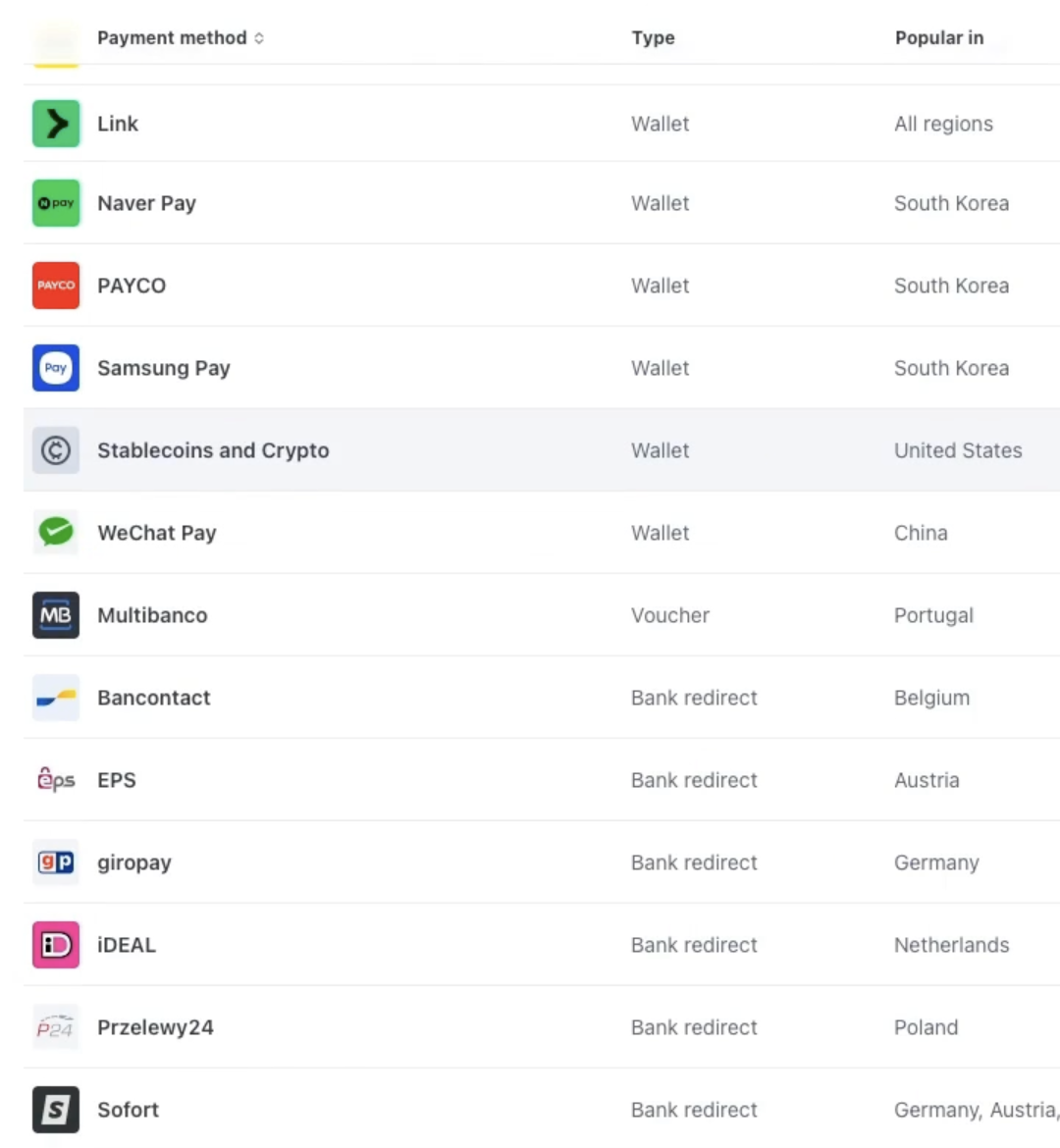
Stripe integrates natively with Shopify, WooCommerce, Magento, Squarespace, and virtually every major e-commerce platform. Stablecoin payments can be activated directly from the Stripe dashboard — no extra plugin needed if the merchant already uses Stripe as their payment processor.
 This is a massive advantage: zero technical friction for the millions of existing Stripe merchants.
Coinbase Commerce offers an official plugin for Shopify and WooCommerce. The Shopify integration was strengthened through the Commerce Payments Protocol, which enables USDC payments on Base directly within Shopify's native checkout. For WooCommerce, the plugin installs in a few clicks but requires a separate Coinbase Commerce account. For other platforms, Coinbase Commerce provides embeddable payment buttons and hosted payment links.
Documentation, Webhooks, and Sandbox
Stripe's documentation is widely regarded as the gold standard in fintech. The crypto API follows the same conventions as the fiat API: RESTful architecture, SDKs available in Python, Node.js, Ruby, Go, PHP, Java, and .NET, a full sandbox environment, and granular webhooks for every payment event. A developer already familiar with Stripe can add stablecoins in just a few lines of code.
Coinbase Commerce's API is simpler — and more limited. It operates in a "charge" model (create a charge, receive a confirmation webhook) without Stripe's granularity. The documentation is decent but noticeably less comprehensive. No official SDKs for every language, no sandbox as mature. For an experienced developer, integration is still quick. For a junior team, Stripe offers a much better safety net.
That said, Coinbase Commerce's API is expanding on the x402 protocol side, which targets blockchain developers and API architects. This open standard lets developers integrate crypto payments at the HTTP level, without going through a third-party payment API — a radically different approach that could appeal to web3 developers.
Bridge and the OCC: Stripe's Banking Strategy
Stripe's acquisition of Bridge for $1.1 billion in October 2024 stands as the largest acquisition in crypto history. Bridge is a stablecoin orchestration platform that enables businesses to create, send, and convert stablecoins across blockchain networks. As detailed by insights4vc, this acquisition gives Stripe a complete infrastructure for managing stablecoin flows without relying on any third party.
The most strategic move came in February 2026, according to CoinDesk: Bridge received preliminary approval for a national bank charter from the Office of the Comptroller of the Currency (OCC). If the charter is finalized, Bridge will become a federally chartered U.S. bank specializing in stablecoins — capable of issuing tokens backed by deposits, custodying reserves, and operating as a regulated bridge between traditional finance and blockchain.
This strategy positions Stripe far beyond a simple payment processor. With Bridge, Stripe could become the issuer of its own stablecoin, control the entire value chain end-to-end, and offer merchants integrated crypto banking services — stablecoin deposits, treasury management, and automatic conversion between fiat and crypto currencies.
Coinbase isn't sitting still on the regulatory front. The exchange already holds money transmitter licenses in the majority of U.S. states, is SEC-regulated as a publicly traded company, and operates in Europe under the MiCA (Markets in Crypto-Assets Regulation) framework. But Coinbase Commerce, as a product, doesn't share Bridge's banking ambitions. Its strength lies in the ecosystem: Base, the wallet, the exchange, staking — a complete crypto-native stack rather than a bridge to traditional finance.
Which Processor Should You Choose Based on Your Business Model
Traditional E-Commerce and Marketplaces
For a mainstream e-commerce store with a predominantly non-crypto customer base (i.e., the vast majority of online shops), Stripe is the obvious choice. The fiat-to-crypto onramp eliminates friction for the end customer. Automatic fiat conversion keeps your accountant happy. Native integration with Shopify and other platforms takes minutes. The extra 0.5% compared to Coinbase Commerce is easily absorbed by the operational simplicity.
For a crypto-native marketplace (NFTs, web3 services, token sales), Coinbase Commerce offers a more cohesive experience for the target audience. Buyers already have a wallet, already pay in crypto — and the 1% fee is among the lowest in the market.
SaaS, Subscriptions, and Recurring Payments
Stripe has dominated recurring payments for over a decade. Its subscription management, failed payment handling, and dunning (automated retry) system is the SaaS industry standard. Adding stablecoins means customers can pay their subscription in USDC — while keeping the full Stripe billing engine intact.
Coinbase Commerce does not support recurring payments natively. Every payment is a one-time transaction that the customer must manually initiate. For a SaaS company with hundreds of clients on monthly subscriptions, that's a deal-breaker. PayPal, which launched its own stablecoin PYUSD, doesn't offer crypto recurring billing either — Stripe overwhelmingly dominates this segment.
Freelancers and International Payments
A freelancer in the U.S. invoicing clients in Brazil, Nigeria, or the Philippines can use stablecoins to bypass international wire transfer fees (often 3-5%) and banking delays (2-5 business days).
With Stripe, the client pays in their local currency via the onramp, Stripe converts to USDC, and the freelancer receives funds in their U.S. bank account in dollars. The process is smooth but costs 1.5%.
With Coinbase Commerce, the freelancer sends a payment link, the client pays in USDC from a wallet, and the funds arrive instantly in the freelancer's wallet. Cost: 1%. The freelancer can then convert to USD on Coinbase Exchange or hold their USDC — and potentially deploy them in DeFi protocols to earn yield.
For crypto-savvy freelancers with clients who are also comfortable with wallets, Coinbase Commerce is more cost-effective. For those working with traditional businesses, Stripe remains more practical.
Frequently Asked Questions
Stripe Crypto or Coinbase Commerce: Which should I choose for my e-commerce site in 2026?
If your customer base is primarily mainstream and doesn't hold cryptocurrency, Stripe is the better choice thanks to its fiat-to-crypto onramp and automatic USD conversion. If your customers are crypto users who already pay with wallets, Coinbase Commerce offers lower fees (1% vs 1.5%) and a native blockchain experience.
What's the actual difference between Stripe and Coinbase Commerce for accepting crypto payments?
Stripe is a fiat processor that adds stablecoins as an additional payment rail — the merchant receives dollars in their bank account. Coinbase Commerce is a crypto-native gateway — the merchant receives cryptocurrency in a wallet. The former simplifies adoption for traditional businesses, while the latter optimizes costs for businesses already embedded in the crypto ecosystem.
Does Stripe let me receive USDC payments directly in my bank account?
Yes. Stripe automatically converts USDC payments into fiat currency (USD, EUR, etc.) and deposits them in the merchant's bank account, with a 1.5% fee per transaction. Merchants can also choose to hold USDC if their Stripe account supports it, but the majority of users opt for automatic conversion.
Does Coinbase Commerce work with Shopify and WooCommerce without an extra plugin?
For Shopify, the Coinbase x Shopify partnership via the Commerce Payments Protocol enables native integration of USDC payments on Base directly within Shopify's checkout flow. For WooCommerce, an official Coinbase Commerce plugin is required — it installs in a few minutes from the WordPress directory. In both cases, full setup takes less than 30 minutes.
Will Coinbase's x402 protocol change the way we pay on the internet?
The x402 protocol, co-developed by Coinbase and Cloudflare, enables native crypto micropayments at the HTTP level — without going through a third-party payment gateway. Its potential is enormous for AI APIs, premium content, and machine-to-machine payments. However, widespread adoption will depend on integration by major browsers and web servers, which remains a multi-year horizon.
For a SaaS with international customers, is Stripe or Coinbase Commerce better for crypto payments?
Stripe is the only viable option for a SaaS with recurring subscriptions. Coinbase Commerce doesn't support recurring payments — every transaction must be manually initiated by the customer. Stripe allows automatic monthly stablecoin billing with the same dunning and failure management mechanics as traditional credit card payments.