
 4.8
4.8 4.5
4.5Binance Review 2026: Is It Still the Market Leader?
Our Verdict
✅ Our take on Binance is straightforward: It remains the most innovative market leader, offering an extensive selection of cryptocurrencies backed by the platform's massive scale, while maintaining some of the lowest fees among major crypto exchanges.
Binance is the undisputed global leader in the cryptocurrency ecosystem.
Known for its highly competitive fees and massive liquidity, the platform enables investors to diversify their portfolios across hundreds of assets, from Bitcoin to emerging crypto projects.
Far more than a simple exchange, it offers a complete ecosystem: staking solutions for generating passive income, a payment card, and an integrated Web3 wallet for decentralized finance.
By using BNB, the platform's native token, you optimize your trading fees while accessing exclusive opportunities.
While the interface can be overwhelming, Binance remains the most robust and well-regulated tool for managing your digital assets.
Pros & Cons of Binance:
Pros
-
✅ PSAN registration with French AMF. Strong regulatory framework.
-
✅ SAFU insurance fund. User protection in case of security incidents.
-
✅ Binance Earn. Staking options for generating passive returns.
-
✅ Among the lowest fees in the industry. 0.1% or less with BNB.
-
✅ World's deepest liquidity.
-
✅ Over 350 cryptocurrencies available.
Cons
-
❌ Mandatory KYC verification.
-
❌ Complex interface. Can overwhelm beginners.
-
❌ High withdrawal fees on certain blockchains.
-
❌ BNB dependency to optimize fees.
-
❌ The overwhelming number of options can be confusing.
-
❌ Support delays during high-traffic periods.
Binance Overview
| Feature | Details |
|---|---|
| Founded | 2017, by Changpeng Zhao |
| User Base | Over 250 million worldwide |
| Available Assets | Over 350 cryptocurrencies |
| Base Trading Fees | 0.1% (25% discount with BNB) |
| Security | SAFU insurance fund (over $1 billion) |
| Web3 Tools | Integrated wallet with MPC technology |
| Regulation (France) | PSAN registered with AMF |
Available Cryptocurrencies
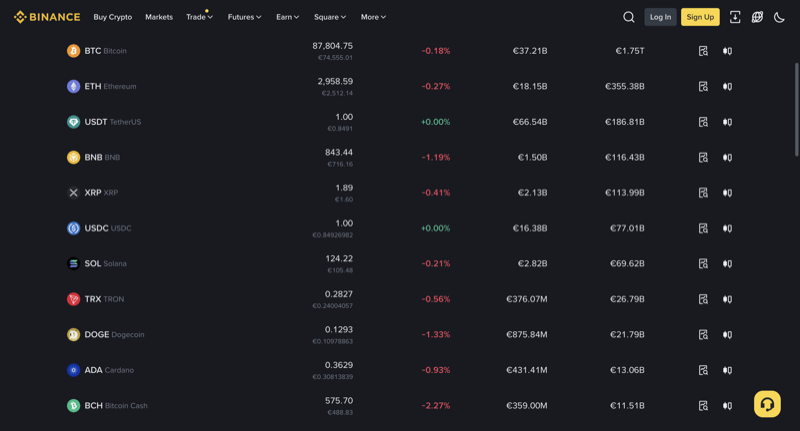
Binance provides access to major market assets, including:
- Bitcoin (BTC), Ethereum (ETH)
- Solana (SOL), Ripple (XRP), BNB
- Emerging sectors: AI projects like Bittensor (TAO), RWA protocols like Pendle
Binance Fees: An Aggressive Pricing Strategy from a Market Giant
For any investor, fees are critical. Binance built its reputation on "aggressive" pricing, making it one of the most economical exchanges on the market.
Deposits and Withdrawals: Bank Transfers Are Your Best Bet
Good news: cryptocurrency deposits are completely free. For fiat currencies (USD/EUR), fees vary by method:
| Method | Fees |
|---|---|
| SEPA Transfer | $1 flat fee |
| Debit/Credit Card | 1.80% |
| Crypto Deposit | Free |
Spot Trading Fees
| Tier | Maker / Taker | With BNB Discount |
|---|---|---|
| Standard | 0.1% | 0.075% |
| VIP 1 (25 BNB) | 0.075-0.1% | 0.05-0.075% |
| VIP 3 (250 BNB) | 0.042-0.06% | 0.0315-0.045% |
BNB: Your Key to Lower Fees
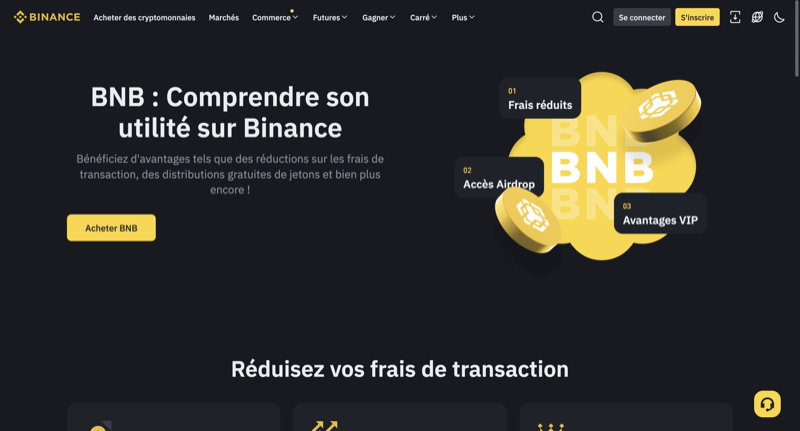
BNB is Binance's native token. Using it gives you:
- Automatic 25% discount on all trading fees.
- VIP tier progression through volume and holdings.
- Access to exclusive token distributions via Launchpad.
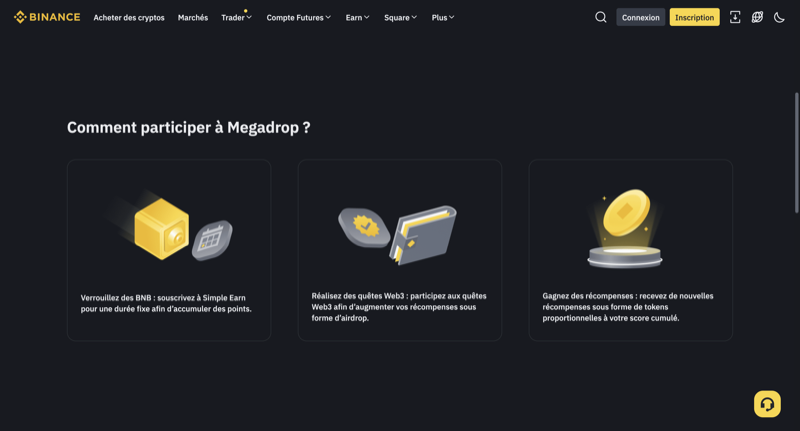
- Megadrop participation for receiving airdrops.
As you climb the VIP levels through your trading volume or BNB balance, these fees become among the world's lowest. Here's how the fee structure evolves based on your commitment:
Auto-Invest (DCA): Hands-Off Investing
Binance offers an automated investment tool that lets you buy cryptocurrencies at regular intervals. It's the ideal method for beginners looking to dollar-cost average without worrying about market timing.
Launchpool & Megadrop: Access New Projects Early
Launchpool distributes tokens from new projects to BNB holders. Simply lock your BNB to receive rewards.
Megadrop offers airdrops in exchange for completing Web3 quests and locking BNB.
Growing Your Assets with Binance Earn
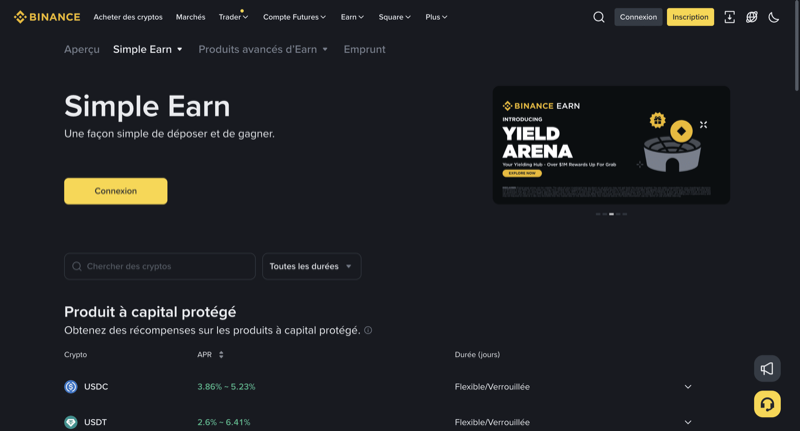
Once you've acquired your cryptocurrencies, Binance Earn lets you generate passive returns through staking.
By simply locking your tokens to support blockchain security, you receive daily rewards directly to your wallet.
The platform offers a convenient flexible savings option that lets you unlock your funds anytime if you want to sell or transfer them.
Learn and Earn with Binance Academy
Finally, to support your learning journey, Binance Academy offers a "Learn & Earn" program.
The concept is simple: you follow training modules on blockchain and Web3 through videos or articles, and earn cryptocurrencies by passing the final quizzes.
It's an excellent entry point for investors who want to understand the technologies they're funding while being rewarded with real assets.
Security and Innovation: The Web3 Wallet
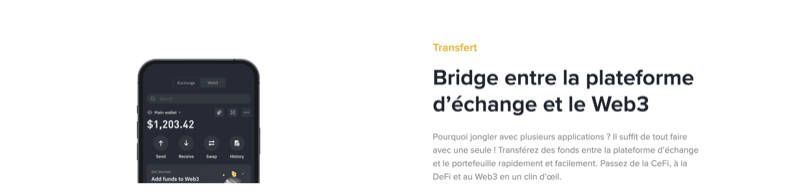
To explore decentralized finance (DeFi), the app now integrates the Binance Web3 Wallet.
This "non-custodial" wallet gives you complete control over your funds while simplifying the user experience.
Thanks to MPC (Multi-Party Computation) technology, you no longer need to fear losing a traditional private key, while enjoying a secure bridge to swap assets across different blockchains.
Trade with competitive fees on Binance — from 0.1% with up to 25% discount using BNB. The world's largest exchange by volume.
FAQ
What's the difference between Binance and other crypto platforms?
Binance stands out primarily through its global liquidity volume, which is the highest in the market, and its trading fees among the lowest (0.1% base rate). Unlike competitors, the platform offers over 350 cryptocurrencies and a complete ecosystem integrating staking, Web3 wallet, and payment card. Its native BNB token also provides a 25% fee discount, a unique advantage few platforms offer.
Is Binance regulated and secure in France?
Yes, Binance is registered as a PSAN (Digital Asset Service Provider) with the AMF (French Financial Markets Authority) and has maintained this registration for several years. The platform also maintains a SAFU insurance fund exceeding $1 billion to protect users in case of security incidents. KYC verification is mandatory, reinforcing compliance with European standards.
How much does trading on Binance cost?
Standard trading fees are 0.1% per transaction, but they can drop to 0.075% when using BNB to pay fees. For high-volume traders, VIP users can benefit from reduced fees down to 0.042%. SEPA transfer deposits cost a flat $1, while debit/credit card deposits are charged 1.80% of the amount.
Is Binance suitable for crypto beginners?
Binance offers beginner-friendly features like Simple mode and detailed tutorials, but its interface remains complex given the multitude of available options. New users can feel overwhelmed by the number of services (spot, futures, staking, NFT, etc.). For a first investment, it's recommended to start with basic buy/sell functions before exploring advanced options.
What are the withdrawal fees on Binance?
Withdrawal fees vary significantly depending on the blockchain used for cryptocurrency transfers. For example, withdrawing Bitcoin can cost between 0.0002 and 0.0005 BTC depending on network congestion. USD/EUR withdrawals via SEPA transfer are generally free or charged at low cost, but some blockchains like Ethereum can have relatively high fees during periods of heavy activity.
How does staking work on Binance?
Binance Earn allows you to stake your cryptocurrencies to generate passive income with variable annual yields depending on the assets. Flexible staking allows you to withdraw your funds anytime, while locked staking offers higher rates in exchange for a defined lock-up period. Rewards are distributed automatically and can be reinvested to maximize compound gains.
Is BNB required to use Binance?
No, using BNB is not mandatory, but it's highly recommended to optimize trading costs. Holding BNB provides an automatic 25% discount on transaction fees and facilitates access to VIP tiers for regular traders. The token also offers exclusive benefits like participation in new project launches via Binance Launchpad, but you can trade normally without owning any.