Bitcoin is a blockchain used by millions of people worldwide, and it's the largest decentralized network in the cryptocurrency space.
With its native currency -- also known as BTC -- its core purpose is to serve as a decentralized medium of exchange that cuts out middlemen like banks and governments. Bitcoin represents nothing short of a revolution in global finance.
But how does Bitcoin actually work? And what's the real point of BTC? Here's everything you need to know about the most valuable cryptocurrency on the planet.
What does BTC actually do in the real world?
We're going to break down the essentials of how this pioneering technology works and why it matters.
What is Bitcoin?
Bitcoin (BTC) is both a digital currency and the decentralized network on which it's exchanged.
Unlike traditional fiat currencies such as the US dollar or the euro, BTC is entirely digital and isn't issued or controlled by any central bank or single authority.
Bitcoin was designed to enable exchanges, payments, and transfers from entity to entity or person to person (peer-to-peer, or P2P) without requiring a financial intermediary.
BTC is the monetary unit of this network. The key appeal of this currency lies in its freedom and accessibility: anyone can use it, anywhere in the world, at any time -- all you need is an internet connection.
It runs on a public, transparent ledger called the blockchain, which guarantees the integrity of every transaction.
On top of that, the Bitcoin protocol introduces digital scarcity by capping the total supply at 21 million units -- a characteristic that sets it radically apart from traditional currencies.
In short, Bitcoin is:
A fixed-supply asset (21 million).
A digital currency (BTC).
A decentralized network (the blockchain).
A trustless system with no middlemen (P2P).
The history of Bitcoin
To understand how Bitcoin was born, don't look at a computer -- look at the financial headlines from 2008. The world was drowning in the subprime mortgage crisis. Banking giants deemed "too big to fail" were collapsing one after another, starting with Lehman Brothers.
The crisis exposed a brutal truth: the money citizens thought they owned in the bank was nothing more than a line of code in an opaque system, managed by institutions that had betrayed public trust.
It was in this climate of crisis -- with governments printing money hand over fist to bail out the banks -- that the first cryptocurrency in history was born.
When was Bitcoin created?
Bitcoin wasn't born by accident. It was born out of necessity. Officially, Bitcoin's birth certificate is dated October 31, 2008. On that day, a person (or group) using the pseudonym Satoshi Nakamoto published a 9-page technical document -- the now-legendary "White Paper."
Its title was understated but revolutionary: "Bitcoin: A Peer-to-Peer Electronic Cash System."
However, the network didn't truly come alive until a few months later. On January 3, 2009, Satoshi Nakamoto mined the very first block on the chain, known as the Genesis Block. This moment was historic -- not just technically, but symbolically. Satoshi embedded a coded message in the raw data of the block, a headline from that day's edition of The Times:
"The Times 03/Jan/2009 Chancellor on brink of second bailout for banks."
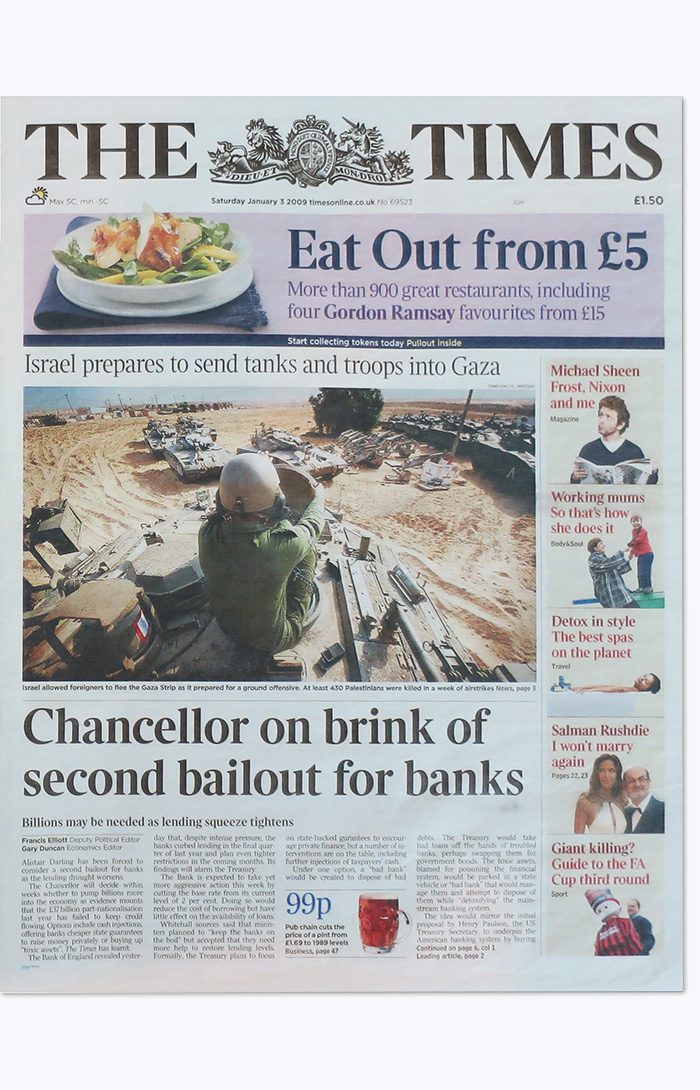
That message was a political statement. It signaled that Bitcoin was created to break free from a financial system capable of devaluing ordinary people's savings to cover the mistakes of bankers. Bitcoin was born to restore monetary sovereignty.
What was Bitcoin worth at the beginning?
While Bitcoin now trades for tens of thousands of dollars, it's important to remember that in the early days, it was worth absolutely nothing.
Throughout 2009, Bitcoin had no market price whatsoever. It was a "geek's currency," traded by a handful of cryptography enthusiasts testing the network. People were swapping thousands of bitcoins out of pure curiosity, with no financial consideration attached.
The first market price estimate appeared in October 2009, via a site called New Liberty Standard, which pegged BTC's value to the cost of electricity needed to mine it. The calculation produced a laughably small number: $0.0009 per BTC. In other words, a single dollar could buy you roughly 1,300 bitcoins.
The most expensive pizzas in history
For a currency to truly exist, though, it has to buy something real. That happened on May 22, 2010 -- a date now celebrated annually as "Bitcoin Pizza Day."
A developer named Laszlo Hanyecz posted a message on a forum offering 10,000 bitcoins to anyone who'd order him two pizzas. Someone took him up on it.
At the time, those 10,000 BTC were worth about $25. Today, that transaction would be worth hundreds of millions of dollars. It was the first time Bitcoin crossed from the virtual world into the physical one, establishing its first real market value.

Who holds the most Bitcoin?
As Bitcoin has gained mainstream traction and publicly traded companies like MicroStrategy and asset managers like BlackRock have accumulated hundreds of thousands of bitcoins, a natural question arises: who owns the most Bitcoin in the world?
Against all expectations, the largest Bitcoin holder remains its creator, the mysterious Satoshi Nakamoto.
Through blockchain analysis, researchers have identified the earliest blocks mined in 2009.
According to these analyses (notably the "Patoshi" pattern), Satoshi is estimated to have mined roughly 1.1 million bitcoins during the network's first months, when he was practically the only one running it.
The most fascinating part? Those funds have never moved.
Since Satoshi's digital disappearance in December 2010 (his last message indicated he was "moving on to other things"), this war chest has remained dormant. It represents a significant portion of the total supply -- roughly 5% of the 21 million bitcoins that will ever exist.
What is a decentralized network?
A decentralized network represents a fundamental break from traditional computing models. Unlike conventional systems where information and control are concentrated at a single point, this model distributes power and data across multiple participants, called nodes. This architecture doesn't just redefine how information is stored -- it reinvents the very concept of digital trust.
No Central Authority and Protocol Resilience
The defining characteristic of a decentralized network is its complete absence of central authority.
Unlike fiat currencies managed by central banks -- the Federal Reserve, the European Central Bank -- or data controlled by tech giants, no single entity holds the keys to the system.
Trust is no longer placed in a fallible human institution but in the computer code itself, known as the protocol.
This protocol dictates strict, immutable consensus rules that every participant agrees to follow. This structure gives the network exceptional resilience: if one node goes down or gets attacked, thousands of others continue operating without interruption.
This redundancy makes the network virtually impossible to shut down and gives it native resistance to censorship.
The Network as a Universal Digital Notary
Within this ecosystem, the blockchain isn't just a passive storage mechanism -- it acts as an active verification tool and a universal notary.
The network is responsible for validating the authenticity of each transaction by verifying cryptographic signatures, then permanently recording it in a shared ledger, making the ownership history transparent and verifiable by anyone.
Technically, fund management differs from traditional banking. When a user -- let's call him "Paul" -- receives funds, the network doesn't simply update a "balance" column. It records a new "unspent transaction" (known technically as a UTXO, or Unspent Transaction Output).
In practice, the network locks these digital funds to Paul's address, and only his private key has the mathematical authority to unlock that UTXO and spend it in a future transaction.
Cryptography and Sovereignty: The Power of Keys
In a decentralized network, the concept of ownership is inseparable from asymmetric cryptography. Everything hinges on the private key, which grants absolute control over assets. When using a digital wallet, this private key serves as the sole proof of legitimate ownership. It generates a unique digital signature required to authorize any movement of funds.
For example, if "Alice" wants to send 1 Bitcoin to "Paul," her software uses her private key to cryptographically sign the transaction. This signature mathematically proves to the rest of the network that Alice initiated the transfer -- without ever revealing her private key.
Meanwhile, the digital address (or public key) functions as an account identifier, allowing other participants to send funds. In short, security and ownership no longer depend on validation by a trusted third party but on mathematical verification performed by a network of peers.
How does the blockchain work?
The blockchain guarantees data integrity and immutability by relying on two fundamental pillars: advanced cryptography and a fully decentralized network of participants.
The Decentralized Nature of the Digital Ledger
To precisely define this technology, think of it as a digital ledger -- public or private -- capable of recording a wide variety of data, from financial transactions to property titles, smart contracts, and digital identities.
This process happens transparently, securely, and in a tamper-proof manner.
The real revolution lies in decentralization. Unlike traditional databases controlled by a central entity like a bank or government, the blockchain is hosted simultaneously by thousands of nodes across a global network.
This geographic and computational distribution makes the system extremely resilient against censorship and technical failures, because no single entity holds the "kill switch."
Block Chaining and Immutability Through Hashing
The blockchain's immutability relies entirely on the hashing process and the chaining of blocks. When a block is finalized, its entire contents -- including the header and, crucially, the hash of the previous block -- are processed by a hashing algorithm, such as SHA-256 for Bitcoin.
This operation generates a unique, fixed-length string of characters: the block's hash. This cryptographic link creates total interdependence between blocks.
Here's where the system's security becomes airtight: if a bad actor tried to alter a transaction in an older block (let's call it Block A), that block's hash would change immediately. As a result, the next block (Block B), which contains Block A's original fingerprint, would no longer match.
This inconsistency would cascade through the chain, invalidating Block B, then C, and so on. In the eyes of the network, the entire chain following the modification becomes invalid -- making tampering mathematically impossible without an absurd amount of computing power.
Consensus and Validation via Proof of Work
Adding a new block to the chain doesn't happen arbitrarily -- it requires network-wide agreement, called consensus. Before integration, each block must be validated by network actors, such as miners, through a specific algorithm. The most famous mechanism is Proof of Work (PoW).
In this system, miners invest energy and computing power to find the right Nonce that will produce a valid hash. This costly work serves as proof that the block was created legitimately.
Finally, to settle temporary disagreements or fraud attempts, the network follows the "longest chain" rule. The version of the blockchain considered the official truth is always the one with the most cumulative work invested.
This economic and mathematical mechanism effectively deters attacks -- especially the 51% attack -- ensuring the long-term reliability of the ledger.
Mining: the backbone of the Bitcoin blockchain
Unlike US dollars that are printed by the Federal Reserve, every unit of BTC in circulation was generated through a complex computational process called Bitcoin mining. This activity is truly the backbone that holds the entire network together.
A lot of newcomers have questions about this industry. How does it work technically? Is it legal to start mining cryptocurrency from your home? And most importantly, what hardware do you need to profitably mine BTC? Here's the essential breakdown.
What's the principle behind mining BTC?
To understand how Bitcoin mining works, imagine a massive global lottery that automatically resets every ten minutes. The process isn't about digging through the web -- it's about securing the worldwide computer network.
The Bitcoin network runs on a system called Proof of Work. Thousands of computers around the world -- the miners -- are in constant competition to solve an extremely complex mathematical puzzle. The first one to find the solution earns the right to add the next block of transactions to the blockchain.
In exchange for this security and transaction validation service, the protocol rewards the winning miner with newly created bitcoins. This is the one and only way new currency enters the market. Mining BTC essentially means converting electricity and computing power into financial value.
Is cryptocurrency mining legal?
This is a perfectly fair question, given how opaque the crypto world can seem to the general public. The short answer is yes. Mining is perfectly legal in the vast majority of countries, including the United States, Canada, the UK, and across the European Union.
However, legal doesn't mean unregulated. If you decide to mine crypto for income, you're subject to the tax laws of your country of residence.
In the United States, the IRS treats mined cryptocurrency as taxable income. The fair market value of the coins on the day you receive them is considered ordinary income and must be reported -- not just when you sell them for dollars. If you mine as a business, it may also be subject to self-employment tax. The SEC and CFTC have also been increasingly active in clarifying how digital assets are classified and regulated.
In Europe, mining is similarly legal, though tax treatment varies by country -- for example, in France, it falls under commercial income (BNC or BIC), while other EU nations may treat it differently under the MiCA regulatory framework.
While some countries like China have banned mining outright, you're free to plug in your rigs and mine cryptocurrency legally across North America and Europe.
What kind of machine do you need to mine?
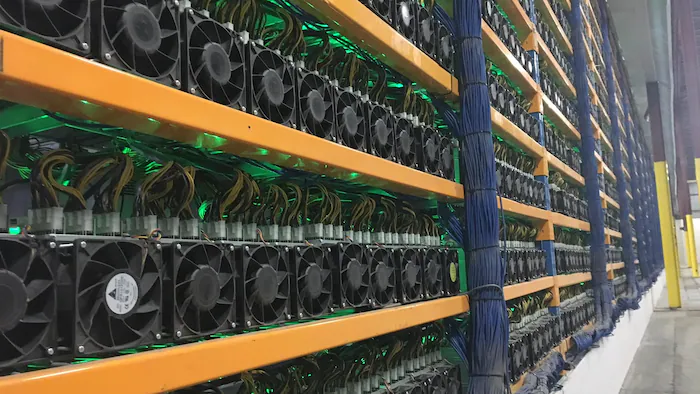
This is where a lot of beginners make mistakes. You simply cannot mine BTC with a regular laptop or desktop computer anymore, like you could back in 2009. The competition has become far too intense for consumer hardware.
For Bitcoin mining, the only viable option today is an ASIC (Application-Specific Integrated Circuit). These are powerful industrial machines designed to do one thing: compute Bitcoin's hashing algorithm. They cost several thousand dollars, are extremely loud, and generate massive amounts of heat.
There are also GPU-based setups -- gaming PC graphics cards assembled into what are called Rigs. These machines are popular for mining alternative cryptocurrencies (altcoins). However, they're completely useless for Bitcoin because they lack the specialized power needed to compete with industrial ASICs.
How do you actually mine Bitcoin?
If you've got the right hardware and a power source, there are three main ways to get started. The most recommended method is joining a Mining Pool.
Going solo against the rest of the world, your odds of finding a block are near zero. To smooth out earnings, miners band together in cooperative groups called Pools. You connect your machine to the pool's server, and the reward is split among all members proportionally. It's the safest way to mine crypto and receive steady payouts.
Another method is Solo Mining. You connect your machine directly to the blockchain without going through a pool. If you find a block, you keep 100% of the reward.
It's the jackpot -- but it's extremely risky. You could mine for years without finding anything unless you're running a massive operation.
Finally, there's Cloud Mining. This involves renting computing power from a company that owns the hardware on your behalf. You don't manage any equipment -- you simply buy a contract to mine BTC remotely. Exercise extreme caution here: many cloud mining offers online are either unprofitable or outright scams.
How is the Bitcoin network secured?
Its strength lies in its core mechanism: Proof of Work (PoW). This system forms an economic and mathematical protocol designed to resist censorship and attacks, ensuring network integrity without any central authority.
The Active Role of Nodes and Distributed Consensus
Network security starts with its distributed architecture. The blockchain is replicated across thousands of computers worldwide, called nodes. Contrary to popular belief, these nodes aren't just passive storage -- they act as independent, rigorous validators. When a miner broadcasts a new block, every node on the network inspects it meticulously to ensure it follows the Bitcoin protocol. They verify that all included transactions are valid, that senders actually have the necessary funds, and that cryptographic signatures are authentic. If a block violates these strict rules, it's rejected by global consensus, preventing any corrupt data from propagating.
Hashing and Immutability: The Indestructible Chain
The integrity of the transaction history is guaranteed by cryptographic hashing. Each generated block contains a unique digital fingerprint -- the hash -- which includes the fingerprint of the previous block. This mechanism creates an unbroken, chronological chain: if a bad actor tried to modify a single transaction in a past block, that block's hash would change instantly. Through a domino effect, all subsequent blocks would become invalid because they'd no longer match their predecessor's fingerprint. To validate such a modification, you'd need to recalculate the Proof of Work for every subsequent block -- a task made deliberately expensive in energy and time by the protocol. This energy barrier is what guarantees the ledger's immutability.
Economic Deterrence and the 51% Attack
This architecture makes the network extremely resistant to brute-force attacks, particularly the infamous "51% attack." To successfully corrupt the ledger -- meaning to alter past transactions or censor new ones -- an attacker would need to control more than half of the total global computing power dedicated to Bitcoin (the hashrate). In practice, this attack has become economically unfeasible. The Bitcoin network being the largest decentralized computing network on Earth, the investment required in specialized hardware (ASICs) and electricity would be astronomical -- far exceeding any potential gains. This economic reality deters attackers and protects the system's longevity.
User-Level Cryptography: Public and Private Keys
At the end-user level, security doesn't depend on computing power but on asymmetric cryptography. The system works through a key pair. The public key generates a Bitcoin address that you can freely share to receive funds. The private key, on the other hand, represents absolute secrecy and total control. It's what allows you to cryptographically sign a transaction, mathematically proving to the network that you're the rightful owner of the funds -- without ever revealing the key itself. In summary, Bitcoin's security is a virtuous cycle: decentralization prevents censorship, hashing ensures integrity, and cryptography protects individual ownership.
Why buy Bitcoin?
Long dismissed as a speculative toy for tech nerds or a tool for the black market, the narrative around Bitcoin has shifted dramatically.
Today, for many investors, buying Bitcoin is no longer a casino bet. It's become a deliberate macroeconomic decision in response to growing uncertainties within the traditional financial system.
Bitcoin as a hedge against inflation
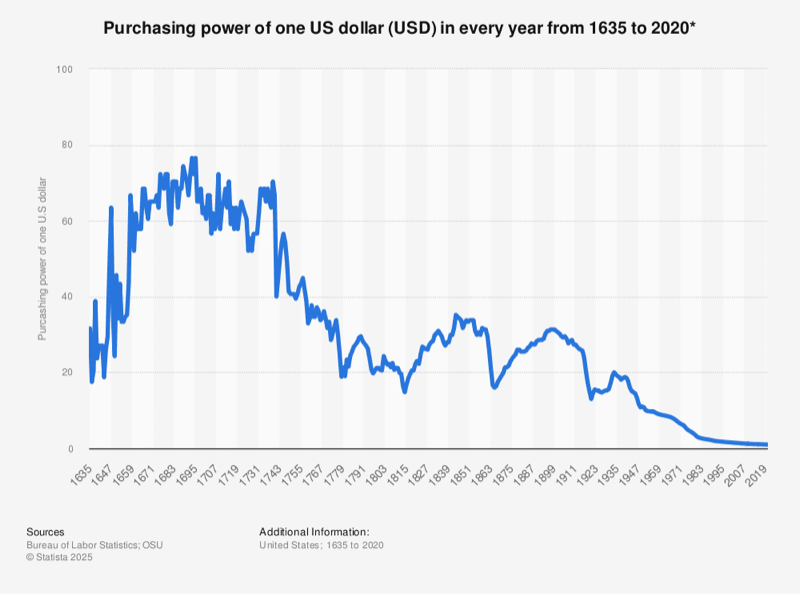
To understand Bitcoin's primary utility, look at what's already in your wallet: the US dollar. It's a fiat currency, and its biggest problem is inflation.
Central banks like the Federal Reserve have the power to print unlimited money to prop up the economy. But this monetary expansion comes at a cost: the more money in circulation, the less each unit is worth. It's this invisible mechanism that erodes your purchasing power year after year.
Against this backdrop, Bitcoin offers an inverted monetary policy. It's a deflationary asset by design. Its code dictates an immutable rule: there will never be more than 21 million bitcoins in circulation.
Nobody -- not a government, not a central bank -- can "print" more to dilute the value held by existing owners. If demand rises while supply remains strictly fixed, the asset's value mechanically increases. That's why many savers use Bitcoin as insurance against the devaluation of their national currency.
Digital Gold: A store of value for the 21st century
The comparison keeps coming back: "Bitcoin is digital gold." This analogy is powerful because it's technically accurate when it comes to the fundamental properties of money. Like gold, Bitcoin is scarce, durable, and impossible to counterfeit.
But Bitcoin has major advantages that physical gold simply doesn't -- making it far better suited for the internet age. First is portability. Moving $10 million worth of gold requires an armored truck, armed guards, and expensive insurance.
Moving the same amount in Bitcoin takes ten minutes. You can memorize 12 words (your recovery phrase) and cross any border with your fortune in your head -- no customs agent can seize it.
Then there's divisibility. While it's hard to pay for a cup of coffee with a gold bar, Bitcoin is divisible down to the eighth decimal place. You don't need to buy a whole bitcoin -- you can invest as little as $10, making it accessible to any budget.
Network power: Why does it have value?
A common criticism is that Bitcoin "isn't backed by anything tangible." That's a fundamental misread. Bitcoin's value rests on the most powerful and secure computing network in the world.
This is called the network effect. Just like a phone is useless if you're the only one who has one, Bitcoin's value increases exponentially with the number of users and miners securing it.
Today, hacking the Bitcoin network would require such colossal energy and hardware costs that no nation-state can realistically attack it head-on. This unbreakable cryptographic security is what gives Bitcoin its intrinsic value: it's the only asset in the world that you truly own, without depending on the permission or solvency of any bank.
Institutional validation: When BlackRock enters the game
While the "digital gold" thesis was championed by early adopters, 2024 marked a historic turning point with the arrival of Wall Street heavyweights.
For years, big bank CEOs called Bitcoin a fraud. Now they're fighting to sell it to their clients. The ultimate symbol of this reversal is BlackRock, the world's largest asset manager.
Under the leadership of CEO Larry Fink -- who now calls Bitcoin a "flight to quality" -- BlackRock launched its own Bitcoin ETF. This financial product lets you buy Bitcoin on the stock exchange as easily as buying shares of Apple.
This institutional validation has two major consequences. First, it grants the asset total regulatory legitimacy. Second, it opens the floodgates for pension funds and corporate treasuries that were previously barred from buying crypto directly.
When these institutions -- which manage the world's savings -- start allocating even a fraction of their portfolios to Bitcoin, the buying pressure on a fixed supply creates an unprecedented supply shock in financial history.
How to buy Bitcoin
While the blockchain technology underlying Bitcoin might seem complex at first, acquiring this digital asset has become considerably more accessible and streamlined for everyday people. The investor's journey now breaks down into a smooth process: selecting a reputable exchange, executing the purchase, and then securing your funds with a personal wallet.
Choosing the Right Exchange
The first step in converting dollars to bitcoin is choosing a trustworthy intermediary. The market splits into two main categories. On one side, centralized exchanges (CEX) such as Coinbase, Kraken, or Gemini operate similarly to traditional online brokerages. They offer intuitive interfaces and responsive customer support, making them ideal for beginners -- though the user doesn't technically hold their own private keys as long as funds remain on the platform. On the other side, Peer-to-Peer (P2P) or decentralized exchanges (DEX) like Bisq or Hodl Hodl connect buyers and sellers directly. While they offer greater privacy, they tend to be less beginner-friendly.
In the US, look for exchanges registered with FinCEN (Financial Crimes Enforcement Network) as Money Services Businesses. Major US-based platforms like Coinbase and Kraken also comply with state-by-state money transmitter regulations. In the EU, the MiCA regulation and France's PSAN registration (via the AMF) provide equivalent consumer protections.
Registration and KYC Compliance
On the vast majority of regulated platforms, total anonymity is a thing of the past. To access buying services, users must go through a rigorous identity verification process known as KYC (Know Your Customer). This procedure -- mandatory for anti-money laundering (AML) compliance -- requires uploading a valid government-issued ID. It's often accompanied by a dynamic selfie (sometimes with a specific head movement to prove a real person is present) and may require a recent proof of address to fully activate the account.
Depositing Funds and Executing the Purchase
Once your account is verified, you need to fund it with fiat currency. In the US, ACH transfers are typically the cheapest method -- usually free, though they can take 1-3 business days to clear. Wire transfers are faster but come with fees. For those who prioritize speed, debit or credit card purchases offer near-instant execution but carry higher transaction fees, often 3-4%. In Europe, SEPA transfers serve a similar role -- generally free but with a 24-48 hour processing window.
The purchase itself is as simple as selecting the BTC/USD (or BTC/EUR) trading pair. Remember: Bitcoin is divisible. You absolutely don't need to buy a whole coin -- you can invest fractional amounts, say $50 or $100, based on your budget.
Securing Your Bitcoin with Digital Wallets
The final step is arguably the most critical, and it echoes the foundational crypto mantra: "Not your keys, not your coins." Leaving your bitcoins on an exchange exposes you to the risk of the platform going under -- because it's the company holding the private keys. To truly own your assets, you need to transfer them to a personal wallet.
There are "Hot Wallets" -- software applications connected to the internet (like Electrum or BlueWallet) -- practical for small amounts and daily use. Then there are "Cold Wallets" -- physical devices disconnected from the network (like Ledger or Trezor hardware wallets) -- which offer maximum security for long-term storage, keeping your private keys safe from any online hacking attempt.
Finally, a critical reminder: Bitcoin is a volatile asset whose price can swing dramatically -- both up and down -- over very short periods. Always do your own research (DYOR) and never invest more than you can afford to lose without impacting your daily life.
Should you invest in Bitcoin?
Now that you understand the technology, the history, and the stakes, the final question is personal and financial: is it a good idea to put your money into Bitcoin today?
The answer can't be a simple "yes" or "no." It depends on your investor profile. That said, the historical data paints a clear picture.
An unmatched historical track record
Looking in the rearview mirror, the numbers are staggering. Bitcoin is unquestionably the best-performing asset of the past decade.
It has outperformed gold, real estate, and major stock indices like the S&P 500 and the Nasdaq.
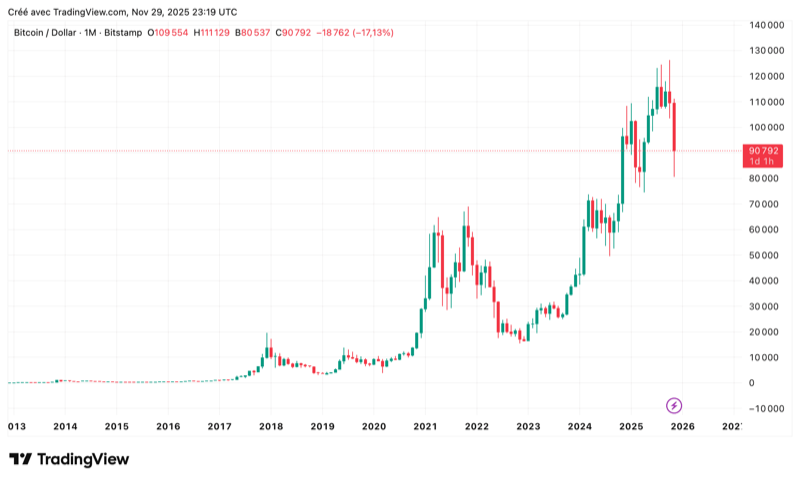
Sure, the ride has been chaotic. Bitcoin's price has seen gut-wrenching drops of -50% or -80% on multiple occasions. That's volatility.
But every single time, it's recovered to reach higher highs. The long-term trend -- on a time horizon of four years or more -- has remained bullish since inception. Those who stayed patient and "zoomed out" have almost always come out ahead.
Growing global confidence: A maturing asset
A decade ago, investing in Bitcoin was an act of faith, even rebellion. Today, it's become a financial strategy validated by the world's biggest players.
Confidence in the network has never been stronger. The hash rate (the computing power securing the network) keeps breaking records, making the system virtually impenetrable.
The arrival of financial giants (BlackRock, Fidelity) and adoption by nation-states (like El Salvador) have changed the game entirely. Bitcoin is no longer a lab experiment. It's a recognized financial asset, integrated into the global economy.
This institutionalization dramatically reduces the risk of Bitcoin vanishing overnight, providing psychological security for new entrants.
Bitcoin as a diversification tool
Should you sell your house to buy Bitcoin? Absolutely not.
The golden rule of investing is diversification -- "Don't put all your eggs in one basket."
Bitcoin plays a specific role in a portfolio: it's a performance booster. For a traditional investor, allocating a small portion of capital -- say 1% to 5% -- to cryptocurrency can be enough.
The idea is the asymmetric bet:
-
If Bitcoin crashes, you only lose that small percentage (1-5%), which doesn't ruin your life.
-
If Bitcoin's price doubles, quintuples, or goes 10x, that small allocation can dramatically boost your overall portfolio performance.
What investment strategy should you use? DCA or "Buy the Dip"?
For stress-free investing, there are two main schools of thought. The first -- ideal for beginners -- is DCA (Dollar Cost Averaging).
Instead of investing $10,000 all at once and hoping you timed it right, you invest $100 every week, automatically. This method smooths out your average purchase price and saves you from obsessing over charts.
For those looking to maximize returns, some investors opt for Lump Sum investing.
This strategy involves investing a significant amount all at once, at a specific moment. The goal is to capitalize on market corrections -- the famous "Buy the Dip" approach.
In the Bitcoin world, price can suddenly plummet -20% or -30% on bad news. For the experienced investor, that's not a sell signal -- it's a sale.
Deploying cash at these precise moments, when fear dominates the market ("blood in the streets"), has historically proven extremely profitable.
The ultimate strategy? Combining both. Many investors set up automatic DCA for the long haul while keeping a cash reserve (in stablecoins) ready to deploy aggressively if the market suddenly tanks. This lets you ride steady growth while seizing rare opportunities.
Can you trade Bitcoin? The market reality
The answer is a resounding yes. Bitcoin has become one of the most actively traded assets on Earth, operating 24/7/365 -- unlike the stock market, which closes evenings and weekends.
That said, don't confuse "investing" (buying and holding for the long term, a.k.a. HODL) with "trading" (buying and selling over short periods to profit from price swings). While anyone can technically trade, very few do it profitably.
The hard numbers: Who actually wins?
Before you dive in, consider these sobering statistics from various studies (including data from the SEC, FINRA, AMF, and major brokers) on retail trading (CFDs and Forex included, applicable to crypto):
-
89% to 90% of retail traders lose money over the long term.
-
The "90-90-90 rule" is often cited on Wall Street: 90% of beginners lose 90% of their capital within 90 days.
-
Only 1% of traders manage to generate income above minimum wage consistently over multiple years.
These numbers aren't meant to discourage you -- they're meant to make you understand that trading is a profession, not a game of chance.
How to trade Bitcoin: The 3 main methods
There are several ways to gain exposure to BTC price movements, ranging from simple to complex.
1. Spot Trading
This is the safest method for beginners. You're buying actual Bitcoin (or fractions of it).
-
How: Through platforms like Coinbase, Kraken, or Binance.
-
Mechanism: You buy BTC at $60,000. If it rises to $66,000, you sell for a 10% profit.
-
Advantage: No leverage means no risk of liquidation (total loss) if the price dips temporarily. You always own the asset.
2. Derivatives (Futures and CFDs)
This is the playground for experienced traders. You're betting on the price going up (Long) or down (Short) without necessarily owning the Bitcoin.
-
How: Through crypto exchanges (Bybit, OKX) or traditional brokers (eToro, Interactive Brokers).
-
The "Short" concept: You can profit when Bitcoin crashes. You borrow one Bitcoin, sell it at $60,000, then buy it back later at $50,000 to return it. You pocket the $10,000 difference.
3. Leverage: The gains (and losses) accelerator
Platforms allow you to use a multiplier. If you have $1,000 and use 10x leverage, you're trading as if you had $10,000.
- The key number: With 10x leverage, it only takes a 10% move against your position for your initial capital to be completely wiped out. That's called "Liquidation."
Volatility and Liquidity: Bitcoin by the numbers
Why do traders love Bitcoin so much? Volatility. An asset that doesn't move doesn't make a trader any money.
-
Annual volatility: Bitcoin is roughly 3 to 4 times more volatile than gold or traditional stock indices (S&P 500). Swings of 5% to 10% in a single day aren't unusual.
-
Dominance: Bitcoin typically represents 50% to 60% of the total cryptocurrency market cap. It sets the trend: when Bitcoin sneezes, altcoins catch the flu.
-
Volume: Tens of billions of dollars in Bitcoin change hands every day. This massive liquidity means you can buy or sell a million dollars' worth in seconds without moving the market.
When governments get in on the action
The battle for monetary sovereignty: Digital currencies and stablecoins
Governments worldwide are scrambling to respond to crypto's rise. In Europe, the European Central Bank (ECB) is accelerating development of a Digital Euro, while the MiCA regulation provides a comprehensive framework for crypto markets.
This is a direct response to the perceived threat of stablecoins -- cryptocurrencies pegged to the US dollar like USDT and USDC. For European policymakers, letting dollar-backed stablecoins proliferate unchecked would amount to allowing the US dollar to privatize transactions within the eurozone.
In the US, the debate is equally intense. The Federal Reserve has been studying a potential digital dollar (CBDC), though it remains politically contentious. The SEC under various administrations has taken aggressive enforcement actions against crypto companies, while Congress continues to debate comprehensive crypto legislation.
The United States at a crossroads: Policy shifts and state-level action
Across the Atlantic, the dynamic is radically different and politically charged. Donald Trump took a firm stance opposing the creation of a US digital dollar (CBDC), calling it a tool for government tyranny and surveillance.
Instead, he proposed a libertarian approach: transforming government-seized crypto into a Strategic Bitcoin Reserve, freezing those holdings rather than selling them off.
But the most concrete revolution is happening at the state level. Texas is leading the charge. With a GDP rivaling countries like Italy or Canada, it's pioneering legislation to create its own reserve of gold and bitcoin.
By doing so, Texas leverages its economic and energy might (it's a global mining hub) to force the federal government's hand, legitimizing Bitcoin as an institutional reserve asset capable of securing the economy of a regional superpower.
Adoption laboratories: El Salvador's gamble and Bhutan's quiet strategy
Far from Western superpowers, smaller nations are using Bitcoin as a lever for financial emancipation.
El Salvador remains the global showcase for this strategy, having adopted Bitcoin as legal tender to break free from IMF dictates and attract foreign capital -- despite criticism from traditional financial institutions.
On the other side of the globe, Bhutan has been executing a far quieter but equally fascinating strategy. Without any fanfare, this Himalayan kingdom harnesses its massive hydroelectric potential to mine Bitcoin at an industrial scale.
Unlike El Salvador, which buys its reserves, Bhutan "produces" them -- converting natural resources into digital gold. It's a strategy now inspiring other energy-rich nations.
The future of Bitcoin: Between technological challenges and long-term viability
Bitcoin has proven its resilience since 2009. However, to become a truly indispensable global standard, it must still overcome major hurdles.
How will the network evolve to accommodate billions of users without sacrificing security? And what happens when all bitcoins have been mined?
The Blockchain Trilemma: The scaling challenge
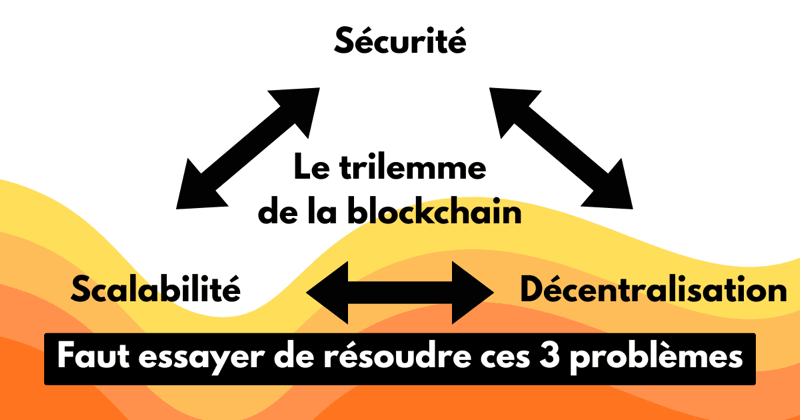
To understand why Bitcoin isn't yet used for everyday payments, you need to grasp a concept theorized by Vitalik Buterin: the Blockchain Trilemma.
This principle states that a blockchain can only optimize two of the following three properties simultaneously:
-
Decentralization: The network belongs to everyone.
-
Security: The network is unhackable.
-
Scalability: The ability to process thousands of transactions per second.
Bitcoin made a radical choice from the start. It prioritizes Decentralization and absolute Security.
The mechanical consequence is low scalability. The main network processes only about 7 transactions per second, making it slow and sometimes expensive during peak usage.
The Lightning Network: Buying your coffee with Bitcoin
If Bitcoin wants to become a universal payment method without compromising its security, it needs to work around this trilemma. The solution isn't modifying the main blockchain but building a second layer on top: the Lightning Network.
Think of it like running a tab at a bar. The Blockchain (Layer 1) is the final settlement -- slow, ultra-secure, like an armored truck moving gold bars.
The Lightning Network (Layer 2) is the tab. You can order 50 coffees (transactions) instantly without pulling out your wallet each time.
Only at the end do you settle up, recording a single final transaction on the blockchain.
Thanks to the Lightning Network, Bitcoin can theoretically handle millions of transactions per second. Fees become virtually zero, finally making it practical to buy a cup of coffee in BTC while still benefiting from the main network's security.
The Halving and the last block in 2140
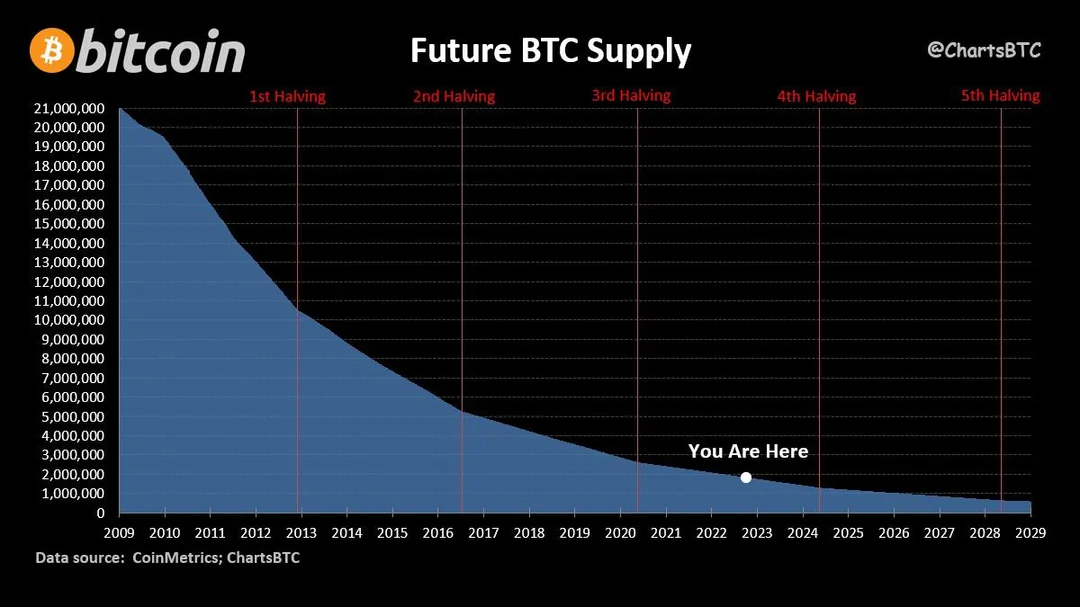
The other big question concerns Bitcoin's economic future. The protocol includes an event programmed every 210,000 blocks (roughly every 4 years) called the Halving.
During a Halving, the reward given to miners for securing the network is cut in half.
-
In 2009: 50 BTC per block.
-
In 2024: 3.125 BTC per block.
This mechanism creates cycles of digital scarcity. If demand holds steady, this production decrease tends to push the price upward.
But what happens when the last Bitcoin is mined?
According to the mathematical calculations baked into the code, the 21 millionth bitcoin will be mined around the year 2140. From that point forward, there will be zero new monetary creation.
The network won't stop, though. Miners -- essential to security -- will no longer be paid in "new bitcoins." They'll be compensated exclusively through transaction fees paid by users. Satoshi Nakamoto's bet is that by then, transaction volume will be sufficient to keep mining profitable.
Can quantum computing hack Bitcoin?
This is the threat that often sounds like science fiction: the rise of quantum computing. These future supercomputers could theoretically crack current encryption algorithms in minutes.
Is Bitcoin in mortal danger?
The answer is nuanced. If a sufficiently powerful quantum computer appeared tomorrow out of nowhere, the network would indeed be vulnerable. The current signature algorithm (ECDSA) could be broken, allowing someone to derive a private key from a public key.
However, Bitcoin is an evolving piece of software. The developer community is already anticipating this threat.
The code can be updated via "soft forks" to integrate post-quantum cryptography protocols. It's a technological arms race: as the attack capability advances, the defense strengthens in parallel.
Furthermore, if you only use a Bitcoin address once (a recommended best practice), your public key is only revealed at the exact moment you spend. A quantum computer would have too narrow a time window to crack the key before the transaction is validated.
Bitcoin isn't a static target -- it's a living system capable of adapting to survive technological disruptions.

Price predictions: How high can Bitcoin go?
This is the question on every investor's lips, from the retail holder to Wall Street executives. Now that Bitcoin is establishing itself on the global stage, what are its limits?
Since the supply is mathematically locked at 21 million units, the price depends on a single variable: demand.
Can Bitcoin reach $1 million?
That symbolic $1 million per coin figure sounds insane. Yet for many financial analysts, it's not a fantasy -- it's a mathematical projection based on comparison with gold.
The reasoning goes like this: if Bitcoin is truly "digital gold," it will eventually reach gold's market capitalization.
Today, the total value of all the world's gold is estimated at roughly $13 trillion. If Bitcoin were to match gold, each unit would be worth approximately $500,000 to $600,000.
But some models go further, like those from ARK Invest or Standard Chartered. They're betting on massive adoption.
If Bitcoin starts capturing even 5% or 10% of the global wealth currently stored in real estate or government bonds, the million-dollar mark could be breached within the coming decade.
This scenario has a name: Hyperbitcoinization. It's the theoretical moment when Bitcoin becomes the world's standard of value, relegating fiat currencies to a secondary role.
Will Bitcoin always have value?
On the flip side, skeptics often ask the fateful question: "What if it all collapses tomorrow?" Can Bitcoin go back to zero?
Technically, for Bitcoin to be worth zero, every single person on Earth would have to stop wanting to use or hold it.
Bitcoin benefits from a powerful phenomenon called the Lindy Effect. This principle states that the life expectancy of a non-perishable technology increases with each day it survives.
Bitcoin has survived -80% crashes, Chinese bans, and the collapse of giants like FTX. Every time the media declares it "dead," it comes back stronger and reaches new all-time highs. This resilience has built deep confidence among millions of users.
On top of that, Bitcoin has an advantage its competitors will never have: it was first.
This is called the First Mover Advantage. Its liquidity and security are so entrenched that it's become virtually impossible for another cryptocurrency to dethrone it as a store of value.
As long as there are individuals seeking a censorship-resistant currency, or citizens living in high-inflation countries looking to protect their savings, Bitcoin will have utility. And as long as it has utility, it will have value.
Important note: These projections are based on economic models and historical trends. They are in no way guarantees of future performance. The cryptocurrency market remains young and volatile.
FAQ
Who created Bitcoin?
Bitcoin was created by a person or group using the pseudonym Satoshi Nakamoto, whose real identity remains unknown to this day. Nakamoto published the Bitcoin white paper in October 2008 and mined the first block in January 2009 before gradually disappearing from public view in 2010. Despite extensive speculation and investigation, no one has been able to definitively prove who is behind the pseudonym.
How do I buy Bitcoin as a beginner?
To buy Bitcoin, start by creating an account on a regulated cryptocurrency exchange like Coinbase, Kraken, or Gemini. After verifying your identity (KYC), you can deposit US dollars via bank transfer (ACH), wire transfer, or debit card, then exchange that fiat currency for BTC. It's strongly recommended to transfer your bitcoins to a personal wallet for optimal security rather than leaving them on the exchange. In the US, major exchanges are registered with FinCEN and comply with state money transmitter laws.
Why is Bitcoin limited to 21 million units?
This 21 million BTC cap was hard-coded into the Bitcoin protocol from the very beginning by Satoshi Nakamoto to create digital scarcity, similar to physical gold. This characteristic makes Bitcoin a deflationary asset -- unlike traditional currencies that central banks like the Federal Reserve can print at will. The last bitcoin is projected to be mined around the year 2140, ensuring complete predictability of monetary supply.
Is Bitcoin legal in the United States?
Yes, Bitcoin is fully legal in the United States. Individuals can buy, sell, and hold bitcoin without restriction. The IRS classifies cryptocurrency as property, meaning capital gains taxes apply when you sell at a profit -- short-term gains (held less than a year) are taxed as ordinary income, while long-term gains benefit from lower capital gains rates. Crypto exchanges operating in the US must register with FinCEN and comply with federal anti-money laundering (AML) regulations. The SEC and CFTC also play regulatory roles depending on how specific digital assets are classified.
What's the difference between Bitcoin and blockchain?
Blockchain is the underlying technology that makes Bitcoin work: it's a public, distributed ledger that records all transactions transparently and immutably. Bitcoin, on the other hand, is both the network that uses this blockchain technology and the cryptocurrency (BTC) that circulates on it. In short, blockchain is the infrastructure, while Bitcoin is the monetary application built on top of it.